Vivaha
विवाह
Wedding Ceremony
The marriage samskara — the most consequential rite in classical Hindu life. Binds two souls (and two families) through Sapta Padi, sacred fire, and the seven mutual vows.
Also known asVivah · Hindu Wedding · Kalyana · Lagna
Traditional timing
When dharma, artha, kama all align (typically late teens to mid-30s)
Typical age / phase
20–32 in contemporary practice
Overview
Vivah is the marriage samskara — arguably the most consequential rite in classical Hindu life. The ceremony combines fire (Agni) as the divine witness, the seven steps (Sapta Padi) around the sacred fire, and the seven vows in which the bride and groom commit to specific aspects of their shared life. It is not merely two individuals being joined but two lineages, two gotras, two karma-streams binding for the duration of this life and (per traditional belief) seven future lives.
Significance
Marriage in the Vedic view is a yajna — a sacrifice. The bride and groom each surrender a part of their individual will to a shared dharma. The seven vows (saptapadi) cover food, strength, prosperity, happiness, progeny, longevity, and friendship — a comprehensive scope. The kanyadana — gifting of the daughter by her father — is among the most weighty acts in classical Hindu liturgy. The Vivah Sukta from Rigveda 10.85 is recited verbatim at every traditional Vedic wedding.
The ritual procedure
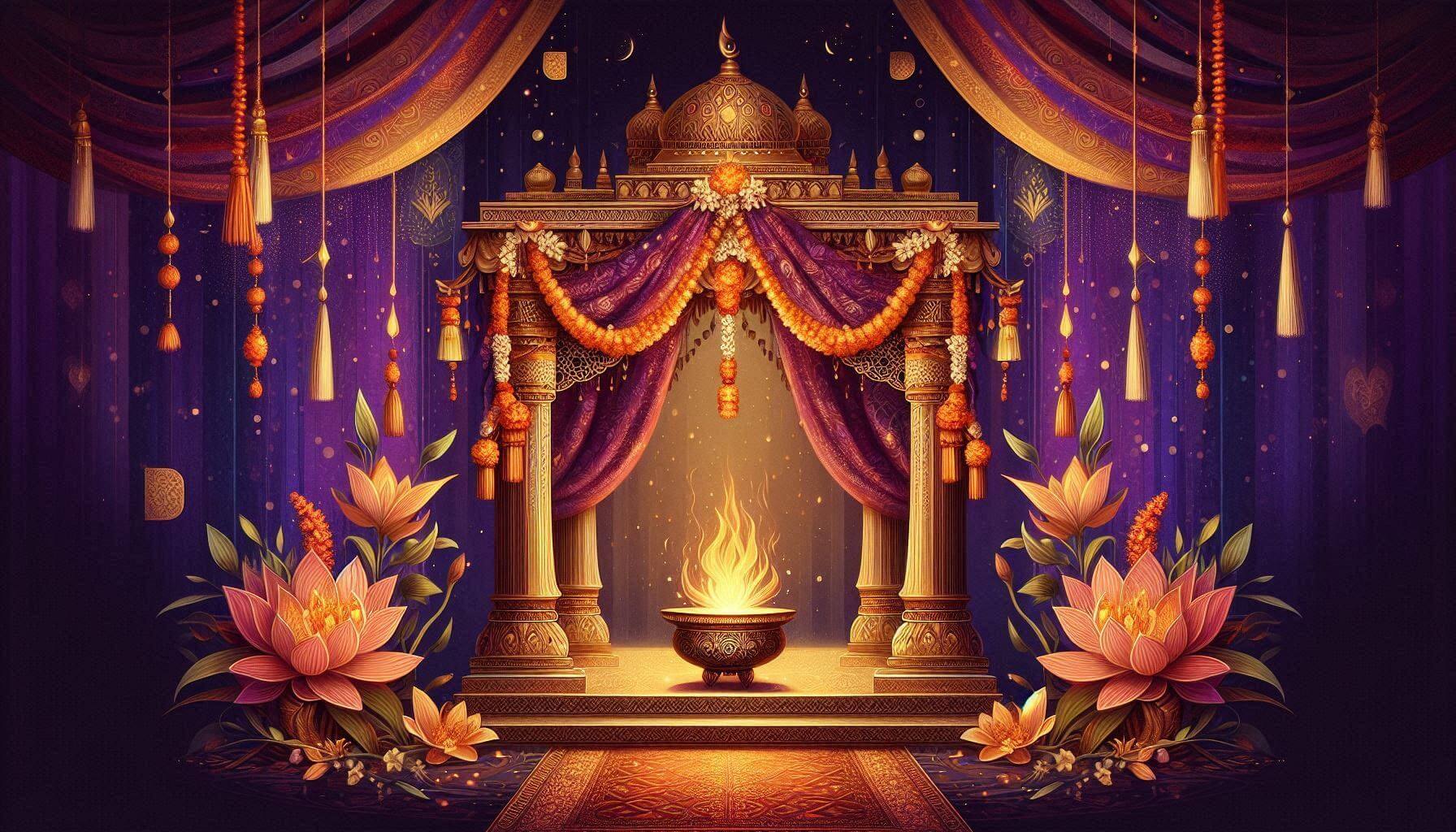
1. Pre-wedding: Mehendi, Sangeet, Haldi. 2. Baraat (groom's arrival procession). 3. Var Mala: bride and groom exchange flower garlands. 4. Mandap entry: bride and groom take seats at the four-pillared canopy with the homa-kund. 5. Kanyadana: the bride's father formally offers her in marriage. 6. Granthi Bandhan: a knot is tied joining the bride's sari and groom's shawl. 7. Mangal Phera: 4 or 7 circumambulations of the fire. 8. Sapta Padi: 7 steps with seven vows. 9. Sindoor and Mangalsutra: the groom applies vermillion and ties the sacred necklace. 10. Vidaai: the bride formally departs from her parental home.
Total duration: traditionally 3-7 days; modern practice condenses to 1-3 days.
Muhurta selection — Vedic timing rules
Vivah is the most muhurta-sensitive samskara. The chosen date must clear: an auspicious nakshatra (Rohini, Mrigashirsha, Magha, Uttara Phalguni, Hasta, Swati, Anuradha, Mula, Uttara Ashadha, Uttara Bhadrapada, Revati are favoured); avoid Amavasya, Krishna Chaturdashi, eclipse-adjacent dates; clear both bride and groom's ashtama-shanti windows. Pitru Paksha, Chaturmas (in many traditions), and Kshaya Maas are universally avoided. The vivaha-rashi-koota matchmaking — a 36-point compatibility scoring — is the standard pre-condition.
Find a chart-aware date: Use the Marriage Muhurta tool to scan day-by-day verdicts for the next 30/60/90 days against your birth chart.
Open Marriage Muhurta →Frequently asked
How is the marriage muhurta calculated?⌄
Both family priests typically work from the Panchanga, considering the bride and groom's individual janma-nakshatras, gotra-exclusions, avoided periods, and favoured-nakshatra list. AstroSpeaks's Personal Muhurta tool automates this scan.
What is Sapta Padi and why does it matter?⌄
Sapta Padi ("seven steps") is the legally-binding moment of a Hindu marriage — under the Hindu Marriage Act 1955, the marriage becomes complete with the seventh step.
Can a Hindu wedding be inter-caste or inter-community?⌄
Yes — both legally (under the Hindu Marriage Act and Special Marriage Act) and within several Hindu reform traditions. Traditional Vedic ceremonies can be performed for any couple consenting to the rituals.
Classical source
Rigveda 10.85 (Vivah Sukta); Manu Smriti 3.4-3.43; Asvalayana Grhya Sutra 1.5-1.8
Pick a date
Personal Muhurta for Wedding Ceremony
Chart-aware day + time windows tuned to your birth chart. Avoid the generic auspicious-day calendar; get one matched to YOU.
Open the Muhurta toolAsk the experts
Specific question about Vivaha? ₹49
One question, expert-reviewed answer from our team in 48 working hours. Your specific situation, your chart, your tradition.
Ask an Expert