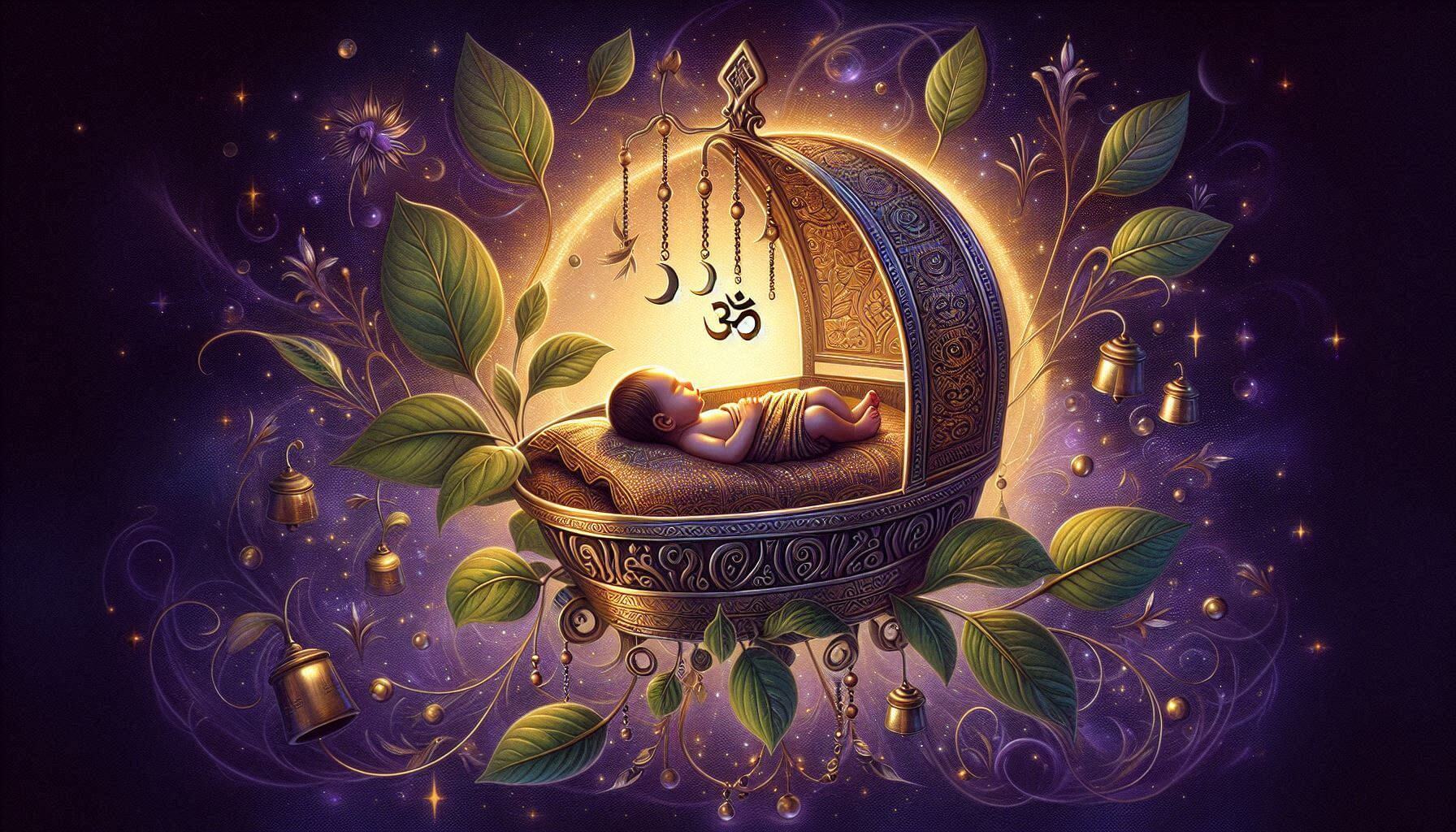
Namakarana
नामकरण
Naming Ceremony
The naming ceremony — performed on day 11 to 21. The chosen name is matched to the nakshatra-pada at birth and whispered into the right ear, sealing the child's identity in dharma.
Also known asNamakaran · Naming Ceremony
Traditional timing
Day 11 to day 21 after birth
Typical age / phase
Newborn (under 1 month)
Overview
Namakarana (the "name-giving") is the fifth samskara and the first publicly attended one. The chosen name is selected by matching the syllable to the baby's nakshatra-pada at birth — a practice that aligns the name with the child's stellar imprint. The ceremony usually occurs on the 11th day (signalling the end of post-birth ritual impurity), the 12th, or any odd-numbered day up to the 21st. In modern practice, many urban families combine Namakaran with the Mundan or Annaprashan to fit guest schedules.
Significance
In the Vedic worldview, a name is not arbitrary — it is a mantra spoken thousands of times across a lifetime, shaping identity through repetition. The nakshatra-pada syllable system pairs the first sound of the name to the constellation under which the baby was born, creating subtle resonance between vibration and consciousness. Beyond cosmology, Namakaran also formalises the child's place in the family lineage (gotra) and is the day many families register the birth officially. The ritual whisper into the right ear is the single most identity-shaping moment in classical Hindu thought.
The ritual procedure
1. Sankalpa: the father or officiating elder declares the family lineage (gotra), pravara (rishi-line), and birth nakshatra. 2. Punyahavachanam: a brief purification ritual cleanses the household after the 10–11 day post-birth period. 3. Mata-pita-pranama: the baby is brought to the family deity altar; parents prostrate. 4. Nama-karanam: the chosen name is whispered four times into the child's right ear. 5. Aarti: a brief lamp circling concludes the rite. 6. Family meal with the priest and close relatives. Sweets are distributed to neighbours.
Total duration: 45 minutes to 1.5 hours.
Items typically required
- •Family deity image or photo
- •Brass or silver platter
- •Diya, incense, camphor
- •Betel leaves and areca nuts
- •Rice grains for offerings
- •Sandalwood paste, kumkum, turmeric
- •A small piece of cloth (vastra) for blessing
- •Sweets (especially modaks or kheer) for distribution
- •The astrologer-prescribed name on a slip of paper or betel leaf
Who performs the ritual
The father formally performs the naming, with the family pandit reciting surrounding mantras. The mother holds the baby. Grandparents typically witness the ear-whisper. In matrilineal traditions (parts of Kerala), the maternal uncle plays a prominent role.
Muhurta selection — Vedic timing rules
Namakaran is auspicious on the 11th, 12th, 16th, or 18th day after birth — odd-numbered days are preferred. Avoid the 13th, the 14th, Sundays, and eclipse periods. Within the chosen day, Choghadiya Amrita, Shubha, or Labha intervals are favoured; Rahu Kala must be avoided. For chart-aware date selection, our Personal Muhurta tool scans for windows where Jupiter (the karaka of children) is unobstructed and the Moon transits a favourable nakshatra.
Find a chart-aware date: Use the Namkaran (Naming Ceremony) Muhurta tool to scan day-by-day verdicts for the next 30/60/90 days against your birth chart.
Open Namkaran (Naming Ceremony) Muhurta →Regional variations
North Indian families perform Namakaran with elaborate brahmin-led recitations and sweets distribution. South Indian Tamil/Telugu/Kannada traditions often combine it with Punyahavachanam. Bengali Annaprashan and Mukhe Bhaat distinguish themselves with rice-pudding emphasis. Kerala traditions feature the maternal uncle prominently. The Sikh equivalent — Naam Karan — happens at the gurdwara; the first letter of a Guru Granth Sahib hymn (taken at random) determines the name's first letter.
Frequently asked
How is the name chosen?⌄
A family astrologer determines the baby's nakshatra-pada at birth (one of 108 possible combinations of 27 nakshatras × 4 padas). Each pada has 1–3 prescribed Sanskrit syllables. The family chooses a meaningful name beginning with one of those syllables.
Can the name be changed later?⌄
Traditionally, no — the Namakaran name is considered permanent in dharma. In practice, families often use a separate calling-name from infancy and gradually shift to the official Namakaran name later.
Should we perform Namakaran exactly on day 11?⌄
Day 11 is the earliest acceptable date (post-jaatashauch). Day 12, 14 (avoided in some traditions), 16, or 18 are equally acceptable. Many families choose a Sunday or holiday closest to those dates for guest convenience, provided the Vedic muhurta is favourable.
Classical source
Manu Smriti 2.30; Asvalayana Grhya Sutra 1.15.4–8
Pick a date
Personal Muhurta for Naming Ceremony
Chart-aware day + time windows tuned to your birth chart. Avoid the generic auspicious-day calendar; get one matched to YOU.
Open the Muhurta toolAsk the experts
Specific question about Namakarana? ₹49
One question, expert-reviewed answer from our team in 48 working hours. Your specific situation, your chart, your tradition.
Ask an Expert